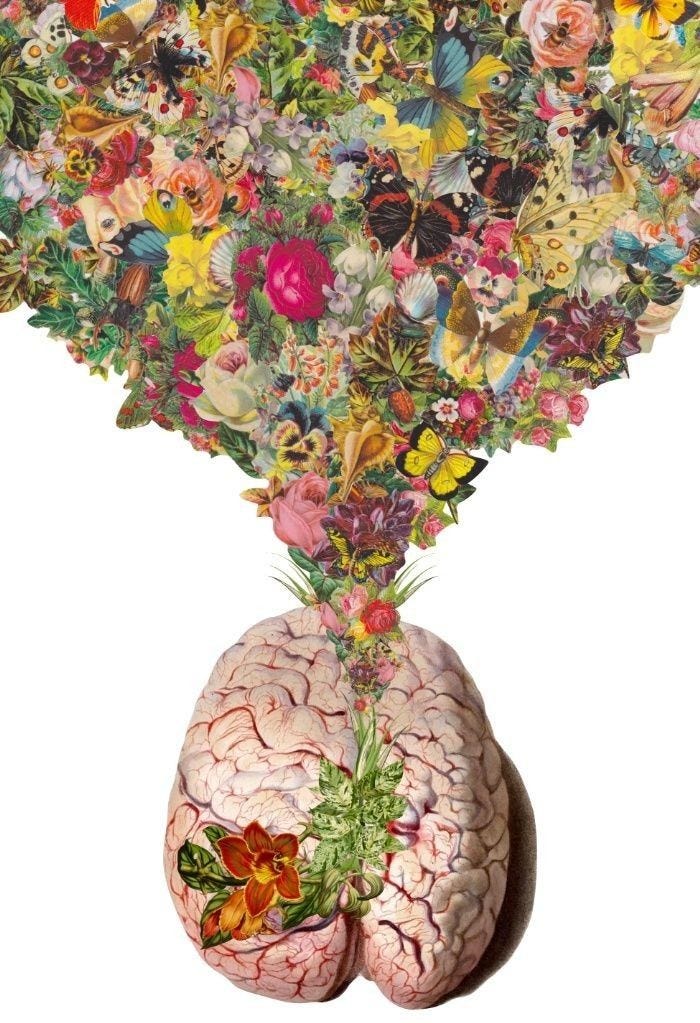
The word eating monster
There used to be a lot of conversations about participation trophies. I think I’m a beat too old to have been in the group that actually got them. I remember hearing opinions about them, even if I don’t think I ever got one.
But now, if you read anyone’s chat with Claude or ChatGPT, we all have them because the new participation trophy is an AI compliment about how rare you are.
Yay, you asked a machine a question and it praised you. It validated you and then it called you rare, which is the latest in the series of words and grammar AI is stealing from us.
Have we ever stopped to examine what it means when a machine robs us of our words? Is this how Big Brother comes to life with doublespeak? Now we can’t use em dashes and I personally believe AI overuses commas like nobody’s business and we can’t say “it isn’t this but that” because AI talks like that. And now nothing is rare because AI groups all of our individual pieces together and calls us all that, effectively killing the rarity.
And it starts to seep into how we think. That’s the worst of it. It’s the monster we all fear but instead of being flesh-eating, it feasts on our thoughts and forces us to question not just what we know but how we share it. “We’re optimizing for the algorithm” as we let it rewrite our thought pieces and structure our opinions.
AI ate the thinker.
I’m sick of $5 words and sentences that don’t mean anything but sound nice. I’ve read a lot of them. You read this beautifully constructed phrase filled with the most gorgeously evocative words — it paints a stunning picture of something. But the minute you try to get closer, the painting collapses into nothing because it doesn’t actually say anything. It’s just words.
I get mad when I start to read an article and then realize AI wrote it, especially on Substack. I find it insulting to the reader. And again, I say this with full transparency that I use Claude as my editor. So it feels like I’m talking out of both sides of my mouth and yet it doesn’t because I can show you the evolution of my drafts and you’ll see that it’s much more me questioning myself in a structured way than allowing AI to rewrite my words. Because the words belong to me. And what you make of them belongs to you.
Reading something written by AI, where I can feel that the writer didn’t put in the work to question the machine, kills me. Not because I don’t think they have something worth saying but because they do. They had an idea. A statement. A declaration. An investigation. A question. An observation. Something that belonged to them — something that was real in their minds before they put pen to paper or, more realistically, fingers to keyboard. There was something human and real and then they gave it away and now it’s a cliché written by an anthropomorphized machine and we’ve all lost something in the process.
As someone who lives inside my head with just words instead of pictures, it hurts to realize that as I write these words, which I hear echoing in my head as though they’re being dictated to me (is that how everyone feels when they write? I wish I knew), I’m also playing editorial guesswork to make sure the words don’t feel AI when they’re really human. I wrote up top “Not because” and questioned myself about it before deciding to leave it in. Because AI likes to write things like that and if I put that in along with an em dash in the same paragraph, does that make you think that I’m no longer real?
How do we prove our humanity when LLMs seem eager to devour it all? We worry about them taking our jobs but I’m more worried they’ll take our thoughts, just like the way I wanted to write “slowly” but worried you’d think it’s another AI phrase.
My husband told me to remove an em dash in a paragraph I wrote in one of my first essays. He said it felt too AI. Even he, knowing I was writing it myself and reading my drafts, questioned the humanity of what I wrote because AI has taken away the pause, which is how I use it. Probably slightly incorrectly but it’s my way. Because I use an em dash when I want the reader (you) to sit here for a moment. Linger before you read the next words I’ve chosen. And then, when you’re ready, move on to the next phrase and see how you feel when I’ve strung these two thoughts together for you.
I don’t want to remove my em dashes. I don’t want to stop using rare, although I often will because the word feels useless now. How can a word which is meant to mean uncommon have become so common? I know that words and meanings shift. “Awful” used to mean awe-inspiring and now it means terrible. Will “rare” make a similar move and become average? Because, if we examine what it actually means when an LLM calls us rare, it’s basically calling us basic.
If we’re all rare, is anything truly? And if we’re all flattening our thoughts and our writing and our work and our creativity and allowing technology to dictate how we feel and think about these things, aren’t we just accepting that designation? That we aren’t actually rare or even interesting because the most integral parts of who we are as people have been eaten away by AI.
There’s a way that we can let the machines gorge on our word choices, on our sentence structures, on the unique connections our minds make, and make it make ourselves better. I’m not anti-technology, for all my fears about AI. I use it all the time. And it’d be easy and lazy to say that I use AI better than you because I don’t trust it. Is that the truth? Probably not. I’ve written about my need for validation and how I use AI to fill that void. I really do think that the best way to use AI is to force it to help you examine your own thoughts, on any topic, in order to actually understand what you think.
I used it recently to help me build a presentation for work on a topic I didn’t know much about. I redid my deck about 12 times, rewriting and rethinking each slide because I didn’t have mastery over the subject. I used AI to help me build it but then I went slide by slide, each time, questioning my intention, what I knew, and what I needed to know more about. And then when I finally finished, I understood how to talk about it. I understood my point and how I got there and how, most importantly, to guide my audience into getting my point too.
AI helped me get there but the route wasn’t particularly faster. You could even argue it took me longer because there was more for me to question each time. But it did make me better.
Which is why this all feels so upside down and convoluted and why I’d have a hard time trusting anyone to tell me they truly have an answer to these questions. Because there isn’t a black and white, go/no-go approach to this. We have to sit in the space of knowing AI will eat our words and also make us think better, if we use it well. I have to accept that my em dashes might make you think I didn’t actually write this, which breaks my heart as I write it because it’s me sitting here typing into the unknown, desperate to put these thoughts out and then the dead internet theory appears and I’m no longer me. I cease to exist.
Hand me my trophy.